
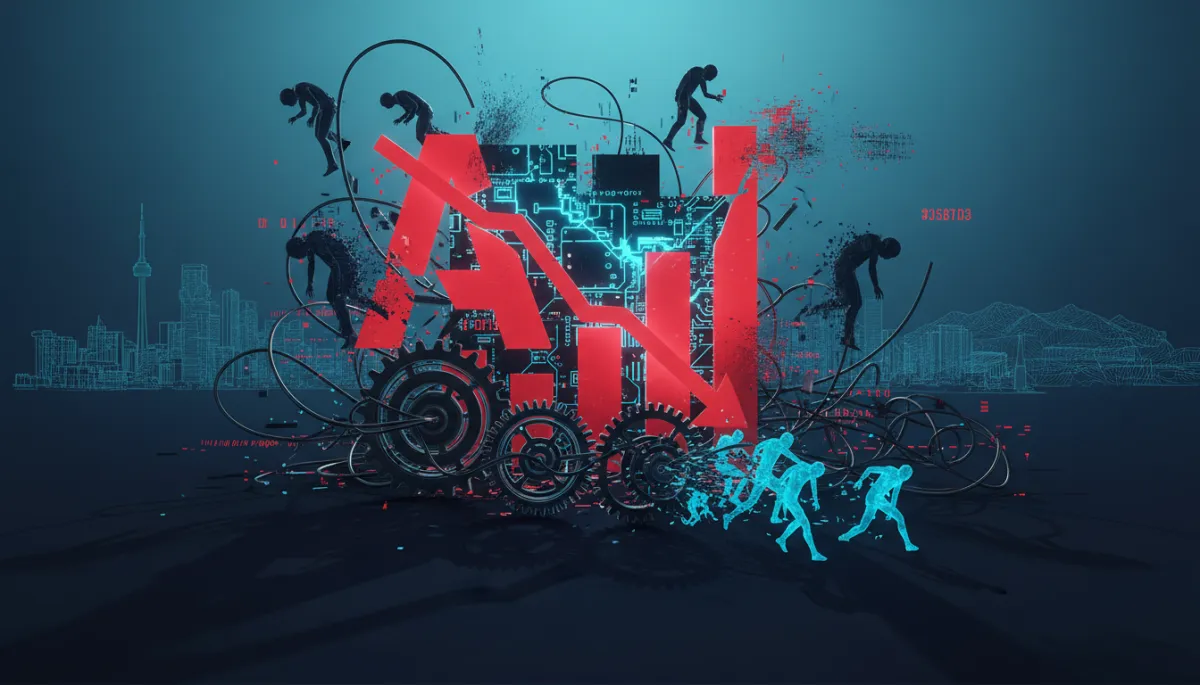
Canadian Companies Regret AI Layoffs in 2026
Shocking News, AI layoffs Canada regret, Canadian companies AI mistakes, tech layoffs Canada 2026, Stiplify
Canadian Companies Are Quietly Firing Workers For AI — And 75% Are Already Regretting It
Across Toronto boardrooms and Vancouver startup lofts, executives spent the last two years betting big on AI-powered layoffs. Now, a growing share are scrambling to walk it back — because the robots aren’t delivering, and the humans they cut are suddenly indispensable again.

The Quiet Canadian AI Layoff Wave No One Wants to Own
If you only read the headlines, you’d think AI layoffs were a U.S. story — Meta, Cloudflare, GitLab and others cutting tens of thousands of roles in the name of “AI efficiency.” But talk privately to HR leaders in downtown Toronto or tech founders in Vancouver’s Gastown, and a different picture emerges: Canadian companies have been quietly trimming marketing, customer support, and junior tech roles, justifying it as “AI-driven restructuring” without ever saying so on the record.
Publicly, there are no major Canadian firms proudly announcing “AI layoffs” in 2026 — CBC, BetaKit and others have not documented a single large-scale, AI-explicit cut this year. Instead, reductions are buried in euphemisms: “productivity initiatives,” “automation gains,” “strategic realignment.” Yet legal and staffing analysis from Robert Half Canada, cited by Canadian employment lawyers, reveals that over one-third of Canadian businesses are now rehiring after overestimating what AI could replace in the first place.
The Brutal Math: Up To 80% Of AI Projects Fail To Deliver
Here’s the part Canadian CEOs don’t put in their shareholder letters: most of the AI they rushed to fire people for doesn’t work at scale. RAND’s 2025 analysis, echoed by consulting firm Pertama Partners, shows that over 80% of enterprise AI projects fail to deliver their intended business value. Gartner adds that roughly 72% of AI infrastructure projects miss ROI targets, with about 20% failing outright. And MIT Sloan reports that around 95% of generative AI pilots never make it to full production.
In other words, when a Canadian retailer in Mississauga or a SaaS startup in Vancouver lays off a human team and plugs in a shiny AI tool, the odds are nearly four to one that the project will stall, underperform, or quietly die. Yet the jobs are already gone. Forrester and Forbes have been warning for years that companies would regret AI-only replacements — and now that prediction is playing out in real time north of the border.

Many Canadian tech firms are now quietly backfilling roles they assumed AI could handle.
Toronto, Vancouver, and the Great AI Rehiring U-Turn
The reversal is most visible in Canada’s tech corridors. BetaKit has chronicled the whiplash: hiring freezes and quiet cuts in 2024–2025, followed by a 2026 pivot to “strategic hiring” in AI, data, and revenue-critical roles. Staffing reports summarized by Robert Half and Permasearch show that only about 5% of tech leaders feel they have the right skills and headcount, while nearly 70% are now focused on upskilling and rehiring — often for roles they previously assumed AI would handle.
In Toronto’s Financial District, banks that trimmed marketing and analytics teams are quietly bringing people back in contract or hybrid roles. In Vancouver, product-led SaaS companies that swapped customer success teams for chatbots are now layering humans back on top to fix churn and brand damage. Nationally, tech salaries rose about 7% in 2025, according to TechTalent, driven by demand for specialists who can make AI actually work instead of just look good in a press release.
“AI Layoffs Canada Regret” Is Becoming a Boardroom Phrase
Ask around Bay Street and you’ll hear the same whispered admission: we moved too fast. Internally, some boards now talk explicitly about “AI layoffs Canada regret” and “Canadian companies AI mistakes” — acknowledging that they overreacted to global headlines instead of listening to their own operators, marketers, and frontline teams. Statistics Canada notes that nearly half of Canadian firms adopted new technologies in the past three years, and a staggering 85.7% had to invest in training to make those tools usable. That’s not “instant savings”; that’s a costly reset.
Meanwhile, global trackers estimate that roughly 70–85% of AI projects worldwide fail to deliver measurable ROI. Canadian executives who fired first and asked questions later are discovering what analysts and cautious operators have been saying all along: AI is powerful, but it’s not a silver bullet — and it absolutely is not a drop-in replacement for thoughtful humans who know your customers, your brand, and your market.
The Smarter Play: Automation That Amplifies People, Not Replaces Them
For Canadian business owners and marketers, the lesson is painfully clear — and, frankly, a little satisfying for those who warned leadership not to gut their teams. The future of tech layoffs Canada 2026 isn’t a race to zero humans. It’s about smart automation that removes drudge work while keeping strategy, creativity, and relationships firmly in human hands.
That’s exactly where Stiplify comes in. Instead of promising fantasy savings from fully autonomous AI, Stiplify helps Canadian companies automate the right 20–30% of workflows — content ops, reporting, campaign execution, lead routing — while giving your existing team superpowers, not pink slips. You keep the people who understand your customers and your brand. Stiplify quietly handles the repetitive, rules-based work that burns them out and slows you down.
If your organization jumped too hard into AI-driven cuts — or you’re feeling the pressure to follow — you don’t need another risky bet. You need automation that respects reality: AI fails often, humans are still your edge, and the companies that win in Canada’s next tech cycle will be the ones that combine both intelligently.
Author: Stiplify Growth Team